Have you ever looked at bamboo sheets online and wondered whether they are really made from bamboo?
You are not alone. One set may say “100% bamboo,” another may say “bamboo viscose,” and another may promise to be naturally antibacterial and eco-friendly. It is not always easy to know what you are actually buying.
The good news is that you do not need a laboratory or a textile degree to make a better choice. Start with the fiber-content label instead of judging the sheets by their feel.
What is the best way to avoid fake bamboo sheets?
Quick answer: Look for a complete fiber statement such as “viscose made from bamboo” or “rayon made from bamboo.” Check for cotton or polyester blends, compare the online listing with the sewn-in label, and verify certification numbers when available. Softness, cooling feel, price, and thread count cannot prove that sheets contain bamboo.
Reviewed August 30, 2026, using guidance from the Federal Trade Commission, OEKO-TEX, GOTS, and Textile Exchange.
What “Fake” Bamboo Sheets Really Means
“Fake bamboo sheets” is not always the most accurate phrase. Many sheets sold as bamboo bedding are made from rayon or viscose created using bamboo as the original plant source.
That does not automatically mean the sheets are counterfeit. The bigger concern is whether the seller clearly explains what the finished fiber is.
For this guide, misleading bamboo sheets may include:
- Polyester or microfiber sheets marketed as 100% bamboo
- Blended sheets that do not clearly disclose the percentages
- Rayon or viscose sheets advertised only as “bamboo” without a useful fiber-content statement
- Products with conflicting information between the product page and sewn-in label
- Bedding making unsupported claims about antibacterial properties or environmental benefits
A cotton-and-bamboo blend is not automatically fake. It simply is not the same as a 100% bamboo-derived product, and the blend should be clearly identified.
Bamboo Sheets Are Often Rayon or Viscose
Bamboo is often used as a source of cellulose for manufactured fibers. In many bamboo sheet sets, the finished textile is rayon or viscose made from bamboo pulp.
So, the sheet is usually not made from strips of untreated bamboo woven directly into fabric. Instead, bamboo cellulose is processed and regenerated into a soft textile fiber.
The FTC says these products should generally be identified as “rayon made from bamboo” or “viscose made from bamboo,” rather than simply “bamboo.”
If you see 100% viscose made from bamboo, that is not automatically a reason to reject the sheets. It is actually a more helpful description than “100% bamboo.”
What different bamboo labels mean
| What the listing says | What you should understand |
|---|---|
| 100% bamboo | Too vague; ask what finished fiber is used |
| 100% viscose made from bamboo | Bamboo-derived regenerated cellulose fiber |
| 100% rayon made from bamboo | Bamboo-derived rayon with clearer fiber wording |
| Bamboo lyocell | Lyocell claimed to use bamboo as the feedstock; verify the details |
| 70% bamboo viscose, 30% cotton | A blend; not fake if accurately disclosed |
| 60% polyester, 40% bamboo viscose | A synthetic blend that should be clearly labeled |
| Bamboo microfiber | Investigate carefully; check the exact fiber percentages |
| Bamboo linen or mechanically processed bamboo | Fiber processed more directly from the bamboo plant; less common in mainstream sheets |
How to Read a Bamboo Sheet Fiber Label
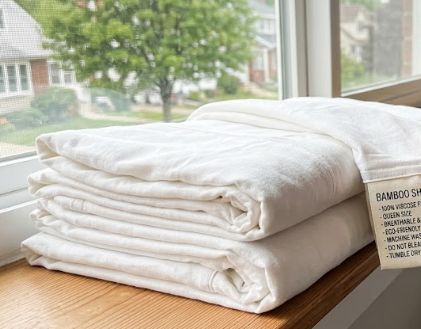
The fiber-content statement is the most useful clue you have. Before buying, check the product details online. When the sheets arrive, check the physical label, too.
Look for:
- The finished fiber name, such as viscose, rayon, lyocell, cotton, or polyester
- The percentage of each fiber
- The country of origin
- The manufacturer, marketer, or registered identification information
- A clear explanation of whether bamboo was used as the source material
A clearer label might say:
100% Viscose Made from Bamboo
Made in China
Company name or RN number
A less useful listing might say:
100% Bamboo
Naturally antibacterial
Eco-friendly luxury fibers
The second example does not tell you enough about the finished fiber. It also combines a vague material claim with performance and environmental promises that may need evidence.
The FTC’s textile guidance explains that covered textile products generally need to disclose fiber content, percentages, manufacturer or marketer information, and country of origin. Those details matter when you shop online and when you inspect the sewn-in label.
A Five-Minute Check Before You Buy
You can usually get a much better idea of what you are buying in just a few minutes.
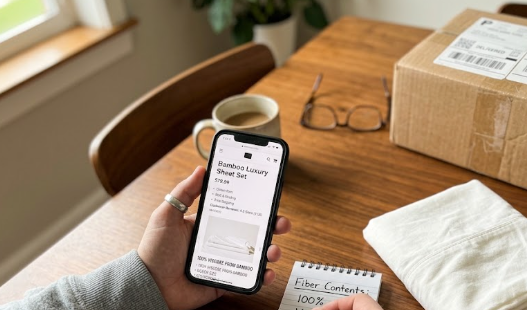
1. Open the full product description
Do not rely only on the product title or the first product image. Scroll down to the technical specifications, materials section, and care information.
2. Find the exact fiber content
Look for a statement that names the finished fibers and gives percentages. Be cautious if the listing only says “bamboo fabric” or “natural bamboo.”
3. Make sure the percentages add up
A product listed as 70% viscose and 30% cotton is easy to understand. If the percentages are missing, unclear, or do not add up to 100%, ask the seller for clarification.
4. Check for polyester or microfiber
If the sheets contain polyester, they are a blend rather than 100% bamboo-derived sheets. That may still be fine if the price and feel suit you, but you should know what you are getting.
5. Compare the listing with the sewn-in label
When the sheets arrive, compare the physical label with the product page and packaging.
If the listing says “100% bamboo” but the sewn-in label says “100% polyester,” take photographs and save screenshots of the original listing. That is a meaningful mismatch.
6. Check the seller’s identity
Look for a company name, customer-service contact information, return policy, and consistent product details. A small or unfamiliar brand is not automatically dishonest, but a seller that provides almost no information deserves extra caution.
7. Verify certification numbers
If the product displays an OEKO-TEX or GOTS logo, look for a certificate number or product ID that you can verify. A logo image alone does not prove anything about the fiber content.
8. Save the listing before ordering
Product pages can change after purchase. Save a screenshot of the title, material details, and certification claims. This gives you a record if the delivered product does not match the advertisement.
Bamboo Viscose, Bamboo Rayon, Lyocell, and Bamboo Linen Compared
Bamboo viscose and bamboo rayon
For everyday shopping, bamboo viscose and bamboo rayon generally refer to the same broad category of regenerated cellulose fibers.
Bamboo is used as the source material, but the finished product is viscose or rayon. These fibers are common in silky, drapey bamboo bedding.
The important question is not whether the sheets are made from a bamboo stalk in its original form. It is whether the seller accurately explains the fiber and avoids misleading claims.
Bamboo lyocell
Lyocell is another type of regenerated cellulose fiber. It is not automatically made from bamboo, so a listing should explain the feedstock if it makes a bamboo-specific claim.
For example, “100% lyocell” tells you the finished fiber type, but not necessarily where the cellulose came from. “Bamboo lyocell” makes a bamboo feedstock claim that you may want to verify through the product details or certification information.
Lyocell may be made using a different production system than conventional viscose, but you should not assume every bamboo lyocell product is automatically more sustainable. Feedstock, chemical management, water, energy, and supply-chain practices still matter.
Mechanically processed bamboo or bamboo linen
Mechanically processed bamboo is closer to what many people imagine when they hear “bamboo fiber.” The plant is processed more directly instead of being chemically regenerated into rayon or viscose.
This type of fiber is less common in the silky sheet sets found in many stores. It may also feel rougher or stiffer than bamboo-derived viscose because the processing and fiber structure are different.
A very soft bamboo sheet is not necessarily fake. Softness may simply indicate that the bamboo cellulose was regenerated into viscose, rayon, or lyocell.
Which Certifications Actually Help?
Certifications can be useful, but they do different jobs. None of them should replace checking the actual fiber-content statement.
OEKO-TEX STANDARD 100
OEKO-TEX STANDARD 100 mainly tests textile components for harmful substances. Bedding is made for direct skin contact, so it falls under relevant product-class testing requirements.
An OEKO-TEX STANDARD 100 certification does not, by itself, prove that:
- The sheets contain bamboo
- The sheets are 100% bamboo-derived
- The product contains no polyester
- Bamboo was processed sustainably
- The sheets are organic
You can use the OEKO-TEX label or product ID to check the certification through its Label Check system.
GOTS
The Global Organic Textile Standard, or GOTS, covers more than a fabric’s name. It addresses organic textile content, processing requirements, chemical inputs, environmental criteria, social criteria, traceability, and labeling.
That makes GOTS useful when you are evaluating organic and processing claims. However, GOTS is not a simple “authentic bamboo” test.
If a brand uses a GOTS claim, look for:
- The GOTS logo
- The label grade
- The approved certification body
- The certification number
- The specific product covered by the certification
You should still read the fiber-content statement to see whether the sheets are viscose, lyocell, cotton, or a blend. You can review the GOTS standard and labeling requirements.
FSC or feedstock certification
FSC chain-of-custody certification can support claims about certified material moving through a supply chain. It may be relevant to bamboo or other plant-based feedstocks.
However, FSC certification does not replace the finished-product label. It does not, by itself, tell you whether your sheets are made from viscose, lyocell, cotton, polyester, or a blend.
Red Flags in Bamboo Sheet Listings
A red flag is a reason to investigate further—not automatic proof that a product is fake.
| Signal | What it may indicate | Is it proof? |
|---|---|---|
| The listing only says “bamboo” | Vague fiber disclosure | No |
| “100% bamboo” appears without a finished fiber name | Important material information is missing | Strong warning |
| The product page and sewn-in label disagree | Possible mislabeling or fulfillment error | Strong red flag |
| No fiber percentages are listed | The composition is unclear | Strong warning |
| “Naturally antibacterial” appears without testing details | Potentially unsupported performance claim | No |
| An unusually high thread count is emphasized | A marketing or construction claim | No |
| The price is unusually low | Possible blend, thinner fabric, or lower-cost construction | No |
| An OEKO-TEX logo is shown | Harmful-substance testing may be claimed | No proof of bamboo |
| A GOTS logo appears without certificate details | Certification claim needs verification | No |
| Reviews mention a plastic-like feel | Possible quality or composition concern | Not scientific proof |
| The seller has no contact information | Limited accountability | A risk factor, not proof |
Be especially careful with terms such as:
- “Bamboo fabric”
- “Natural bamboo”
- “Eco bamboo”
- “Bamboo-derived”
- “Bamboo fiber”
- “Bamboo-like”
- “Bamboo microfiber”
These phrases can appear in different contexts. They do not automatically prove deceptive marketing, but they do not tell you enough by themselves.
Why Price, Softness, and Thread Count Cannot Prove Authenticity
Price, feel, durability, and thread count can help you judge overall value. They cannot identify the fiber with confidence.
Price
Cheap sheets are not automatically fake. A low price may result from:
- A sale or liquidation
- Direct-to-consumer selling
- A thinner fabric
- A blend
- Lower manufacturing or supply-chain costs
- Aggressive marketplace pricing
Expensive sheets are not automatically more authentic, either. Branding, packaging, advertising, and retail margins can all increase the price.
Use an unusually low price as a reminder to inspect the label more carefully—not as proof of fraud.
Softness and cooling feel
Soft, smooth, or cool-feeling sheets can be made from many fibers, including rayon, viscose, lyocell, polyester microfiber, modal, and cotton sateen.
Fabric weight, weave, finishing treatments, room temperature, and your own sleep preferences also affect how sheets feel.
Can you identify bamboo sheets by touching them?
No. If the sheets feel soft, that only tells you how they feel—not what fiber they contain.
Thread count
Thread count can be difficult to compare because yarn size, ply, and manufacturing methods vary.
An unusually high thread-count claim may deserve a closer look, but there is no specific thread-count range that proves sheets are genuinely bamboo-derived. Prioritize the fiber statement, fabric construction, care information, return policy, and seller transparency instead.
Reviews
Reviews can help you notice problems such as:
- Pilling
- Shrinkage
- Color bleeding
- A strong chemical odor
- Poorly fitting pockets
- Plastic-like texture
- A mismatch between the listing and delivered product
Still, reviews cannot scientifically confirm fiber identity. One shopper’s opinion that sheets “feel like bamboo” is not a fiber test.
What to Do If the Sheets Do Not Match the Listing
If the product you receive appears different from what you ordered, take a few simple steps:
- Photograph the sewn-in label, packaging, and sheets.
- Save screenshots of the product page and material description.
- Compare the online listing, packaging, and physical label.
- Contact the seller and explain the specific mismatch.
- Request a return or refund under the seller’s policy.
- Keep copies of your messages and purchase information.
- If the seller will not resolve a serious labeling concern, consider reporting misleading advertising through the appropriate consumer-protection channel, including the FTC’s consumer information resources.
Do not burn the sheets or perform a home fiber test. A burn test creates a fire and inhalation hazard, may damage your evidence, and cannot reliably distinguish bamboo-derived viscose from other regenerated cellulose fibers.
Are Bamboo Sheets Eco-Friendly?
Bamboo grows quickly, but that fact alone does not prove that a finished sheet is environmentally responsible.
With bamboo-derived rayon, viscose, or lyocell, consider four separate questions:
- Where did the cellulose come from?
- How was it converted into fiber?
- Were chemicals, wastewater, water, and energy managed responsibly?
- Is the finished product certified or traceable?
The FTC has warned that some rayon production can involve environmentally harmful chemicals and hazardous air pollutants. Textile Exchange also notes that the sustainability of man-made cellulosic fibers depends on feedstock sourcing and the management of chemicals, water, and energy.
So, be skeptical of broad claims such as “100% eco-friendly bamboo” unless the brand explains what it means and provides credible supporting information.
The same applies to antibacterial claims. Bamboo plants may have antimicrobial characteristics, but you should not assume that finished rayon or viscose sheets retain those properties. Product-specific claims need competent and reliable evidence.
The Bottom Line: Check the Label, Not the Marketing Hype
The easiest way to avoid misleading bamboo sheets is to stop looking for a magic touch test.
Instead, check whether the product gives you:
- A complete fiber-content statement
- Accurate percentages
- Clear identification of viscose, rayon, lyocell, cotton, or polyester
- Consistent information across the product page, packaging, and sewn-in label
- A recognizable seller with contact information
- Verifiable certification details when certifications are advertised
- A reasonable return policy
A label that says “100% viscose made from bamboo” is more useful than one that simply says “100% bamboo.” A clearly labeled bamboo-and-polyester blend is not automatically fake, but it should not be presented as a 100% bamboo-derived product.
For more bedding guidance, you can browse Bamboo-Comfort’s bamboo sheet reviews and buying guides.
Frequently Asked Questions
Is bamboo viscose fake bamboo?
Not necessarily. Bamboo viscose is a manufactured regenerated cellulose fiber made using bamboo as a source material. The concern is whether the seller accurately identifies it as viscose or rayon made from bamboo instead of presenting it as untreated bamboo fiber.
Is bamboo rayon the same as bamboo viscose?
For ordinary shopping purposes, they are generally the same broad category of regenerated cellulose fiber. The FTC recognizes viscose as an alternative name for certain forms of rayon.
Do 100% bamboo sheets exist?
Products marketed as 100% bamboo may exist, but the phrase is too vague by itself. The important questions are how the fiber was made and how it is labeled. Many products called bamboo sheets are actually 100% rayon or viscose made from bamboo.
Does OEKO-TEX prove that bamboo sheets are real?
No. OEKO-TEX STANDARD 100 focuses on testing textile components for harmful substances. It does not prove bamboo content, fiber percentages, or the method used to process bamboo.
Does GOTS prove that sheets are made from bamboo?
No. GOTS provides information about organic content and textile processing requirements. You still need to check the exact fiber composition, label grade, certification body, and certificate number.
Are bamboo sheets made with polyester fake?
Not automatically. They are a blend rather than 100% bamboo-derived sheets. If the product clearly states the percentages, it may be honestly marketed. Whether it is a good value depends on the fabric’s feel, construction, price, and your preferences.
Can I tell whether sheets are bamboo by touching them?
No. Softness, smoothness, and a cool feel can come from several types of fabric. Touch can help you decide whether you like the sheets, but it cannot verify the fiber content.
Are expensive bamboo sheets more authentic?
Not necessarily. Price can reflect branding, packaging, advertising, retail margins, or fabric construction. It is not proof of fiber composition.
Are cheap bamboo sheets fake?
Not necessarily. A low price is simply a reason to inspect the fiber label, seller information, certifications, and return policy more closely.
Do bamboo sheets have antibacterial properties?
Do not assume so. The FTC warns that claims about rayon retaining natural antimicrobial properties from bamboo require reliable evidence for the specific product.
What should I do if the listing says bamboo but the label says polyester?
Take photographs, save the product page, contact the seller, and request a refund or return. If the seller does not resolve a serious mismatch, you can consider reporting the concern to the appropriate consumer-protection agency.